When should you stop using a baby monitor?
Those 140 parents are a poll and not a national study, but it is the best guide we found. The organisation adds that a monitor can sometimes still be useful later on, and that its role then changes. Here is what plays a part at each stage.
How does it change with age?
| Stage | What to think about |
|---|---|
| First six months | Your baby sleeps in your room, so at night a monitor adds little |
| From about six months | With the move to a room of their own, a monitor starts to count |
| Toddler | Your child wakes at night or stands up, and you want to hear it in time |
| Around 3 to 4 years | Your child calls you or comes to you |
| Older | Mainly for exceptions, like staying away or being ill |
The first six months: in your room
Here the advice is clear, unlike the age to stop. The NHS says: "For at least the first 6 months your baby should be in the same room as you when they’re asleep, both day and night." A Dutch regional health service leaflet gives the same six months, in a cot (crib) of their own.
If your baby sleeps next to your bed, a monitor adds little at night. If your baby does nap in another room during the day, a monitor lets you hear what is going on. It doesn’t replace someone being there. "A monitor can never replace a parent or carer’s supervision of a baby", writes the UK charity Lullaby Trust.
After six months: their own room
This is the stage when a monitor starts to add something in many homes. The door closes, and you still want to hear what is going on upstairs from the sofa. It is also a good moment to decide whether you only want to hear or also to see. See audio or video baby monitor.
Toddlers: when do you stop?
There is no day on which it ends, but there are a few signs. If you recognise several of them, try a few nights without it:
- You can hear your child without the monitor, with the doors ajar for example.
- Your child calls you when something is wrong, or comes to you.
- The monitor mostly wakes you for rolling over and mumbling, when your child doesn’t need you.
- You rarely get up for an alert any more.
Start on an evening when you are home anyway and the doors can stay open. If you sleep worse from listening out for nothing, that is an answer too. The other way round is fine as well: you don’t have to stop because your child has reached a certain age.
Sometimes a monitor still earns its place later on. Think of a night somewhere else, like a holiday home with bedrooms far apart, or a sick child sleeping in their own room. If you hear something that worries you, go and look, and call your doctor if in doubt. A baby monitor measures nothing about your child.
Do you really need a baby monitor?
No, not necessarily. The UK charity Lullaby Trust treats it as a choice: "Whether you choose to use a baby monitor or not, you should follow all our safer sleep advice." It also writes that a monitor can never replace supervision. Whether one helps depends mostly on the distance and on what sits between you and your child.
You get more out of one if your child sleeps on another floor, if doors need to stay closed, or if you are often in the garden or a noisy room. You get less out of one if the bedroom is next to the living room and you can hear everything.
Here is how to test that in ten minutes:
- Set the door of the baby’s room the way it is in the evening.
- Sit where you sit in the evening, with the TV at your usual volume.
- Have someone in the baby’s room talk softly, then call out loudly.
- Repeat from the bathroom or the garden, if you are ever there in the evening.
If you hear everything clearly, try going without first. If you hear nothing, you know you need something.
Do you need a baby monitor in a small apartment?
In a small apartment often not, and that test shows it quickly. Walls can be thin and distances short, so you will probably just hear your child. That holds less if you work behind a closed door, if the cooker hood or washing machine is often on, or if a balcony is at the other end of the home. Then you can buy one, or first try it with phones you already have. How to use two phones as a baby monitor explains that.
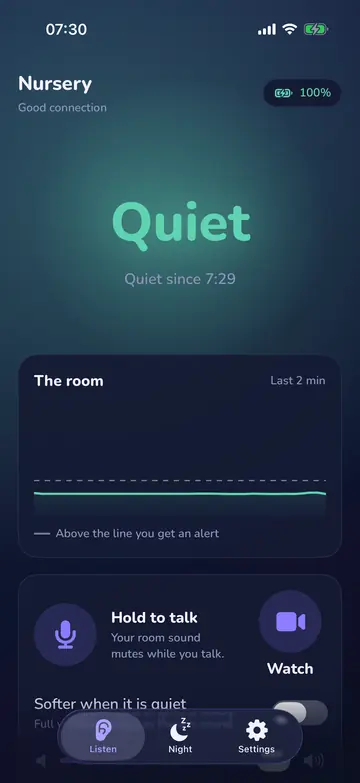
We make NightEar, a free baby monitor app that lets you try this with two phones, and the features page shows what it does.
Common questions
When should you stop using a baby monitor?
No rule says when. In a Consumentenbond poll of 140 Dutch parents, most used one until about age 3 to 4. Stop when you can hear your child without it, or when your child can call you.
When do you start needing a baby monitor?
Usually from the moment your baby sleeps in a different room from you. The NHS and a Dutch regional health service advise sharing a room for the first six months, so before then a monitor adds little at night.
Can a baby monitor stay on all night?
Yes. Place the baby unit at least 1 metre from the cot, with the cable out of reach. If you use a phone, put it on the charger, as its battery won’t last a whole night.
Is it a problem if we don’t use a baby monitor?
No. A monitor is a tool for hearing what is going on, and nothing requires one. Keep following safer sleep advice, with or without a monitor.
Sources
- Consumentenbond, Tot welke leeftijd gebruik je een babyfoon?, in Dutch, updated 24 August 2026.
- GGD Gooi en Vechtstreek, Veilige start 0-6 maanden, in Dutch, PDF from 2018.
- NHS (UK), Helping your baby to sleep, last reviewed 28 January 2025.
- Lullaby Trust (UK), Baby monitors, updated 4 August 2026.
NightEar is not a medical device and does not replace adult supervision.