Do baby monitors give off radiation?
Below you’ll find what those agencies actually write, where the doubt remains and what you can do tonight. We make a baby monitor app for two phones, so we also tell you what that app does not have on this point.
What do health agencies say about baby monitors?
| Source | What they write | What they advise |
|---|---|---|
| Federal Public Service Health, Belgium | Based on available research, "no risk to the baby is expected" (our translation). | Limit exposure as far as possible, at least 1 metre away, voice activation mode |
| Federal Office of Public Health, Switzerland (1 March 2026) | "Based on current scientific knowledge, radiation from baby monitors is not expected to be harmful to health." | At least 1 metre away, adapter at least 50 cm away, voice activation |
| Kind en Gezin, the Flemish child agency | Research does not show that children are more sensitive to radiation (our translation). | At least 1 metre from the cot, preferably with voice activation |
The Swiss office also took measurements. Radiation from audio monitors fell quickly with distance and stayed below the limit every time, even if a child touched the device. It also reports that phones used as baby monitors, at one metre from the child, stay below the limits.
So where does the doubt remain?
The limits protect against heating in the short term. On the long term, the Belgian agency says there is less certainty about whether other effects are possible. Kind en Gezin says much the same. That is why these bodies advise limiting exposure, even though they do not expect harm.
You will also come across two bigger names online. What gets quoted most from them is about holding a phone to your head during calls. A monitor across the room is a different situation.
- The cancer agency IARC, 2011. It classed radio waves as "possibly carcinogenic to humans" (Group 2B), based on a raised risk of one type of brain tumour linked to wireless phone use.
- A review commissioned by the WHO, 2024. It looked at 63 articles. Its conclusion, with moderate certainty, was that mobile phone use likely does not raise the risk of several tumours in adults, or of brain tumours in children.
That review has critics too, who question its design and its authors' background. Microwave News sets out the criticism.
What can you do yourself?
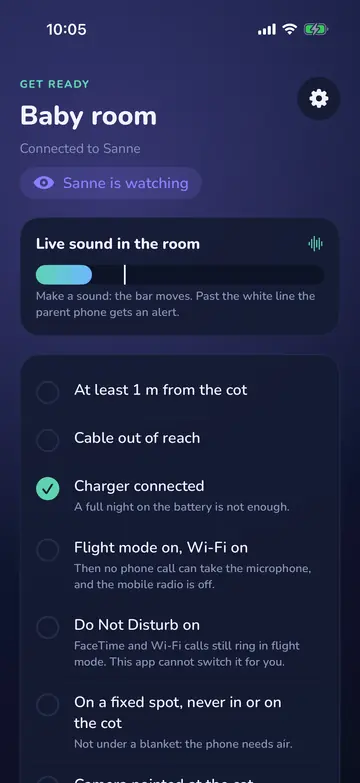
- Place the baby unit at least 1 metre from the cot. All three agencies give this advice, and radiation falls quickly with distance. Never in or on the cot, and never under a blanket.
- Keep the plug away too. The Swiss office names at least 50 cm between the adapter and the cot. With a phone that means the charger, and the cable stays out of your child’s reach.
- Switch off the mobile network. If you use a phone, put it in flight mode and turn Wi-Fi back on. For how that works on an older device, read using an old phone as a baby monitor.
- Turn off Bluetooth on the baby phone. Kind en Gezin suggests switching off wireless functions you don’t use. On the baby phone, NightEar only uses Wi-Fi.
- Use the picture only when you need it. According to the Belgian fact sheet, monitors with video transmit all the time. Many audio units only transmit when they hear sound.
- Voice activation on a separate monitor? Switch that mode on, and before you leave the room, check your baby’s sounds come through. The Swiss office names that check separately, and advises against walkie-talkies if you want low exposure.
Looking mainly for a monitor that works with no Wi-Fi at all? More than radiation comes into that choice. See baby monitor app without Wi-Fi.
What does NightEar do here, and what doesn’t it do?
The baby phone transmits all night, also when it is quiet. NightEar has no voice-activation mode, while the agencies above do suggest one for baby monitors.
There is a reason. The parent phone uses that steady stream to know the line still works. If nothing arrives for 3 seconds, the screen says "Silence on the line". After 10 seconds a loud alarm sounds, also with your screen locked. Some separate monitors handle this with a short test signal every few seconds, the Swiss office writes.
If you want the unit in the baby’s room to transmit as little as possible, a separate monitor with voice activation suits that wish better than NightEar does.
What NightEar does have:
- The Get ready list names 1 metre of distance and flight mode with Wi-Fi on.
- The live picture only runs when a parent taps Watch, and pauses after 3 minutes.
- The baby phone only uses your own Wi-Fi. The mobile network can stay off.
We have not measured radiation from NightEar ourselves, so we give no figures. More practical points are in help on radiation and a good spot.
Common questions about baby monitor radiation
Are Wi-Fi baby monitors dangerous?
The Swiss agency writes that phones and Wi-Fi devices at one metre from the child stay below the limits, and it does not expect harm from baby monitors. The Belgian agency still suggests limiting exposure. Nobody can make an absolute promise, and neither do we.
How far should a baby monitor be from the cot?
At least 1 metre. The Belgian and Swiss health agencies and Kind en Gezin all give that advice. More distance is fine, as long as your baby’s sounds still come through.
Does a monitor without a camera give off less radiation?
A unit with video transmits all the time while the picture runs. Many audio units only transmit when they hear sound, so they spend less time transmitting. With NightEar, the baby phone always sends sound, also when nobody is watching.
Does a phone used as a baby monitor need flight mode?
NightEar also works without it, but we recommend it. In flight mode with Wi-Fi on, the mobile network is off. An ordinary phone call also can’t take the microphone away.
Does NightEar have voice activation?
No. The baby phone sends sound all the time, so the parent phone notices when the line drops.
Sources
- Federal Public Service Health (Belgium), Infofiche draadloze apparaten, in Dutch, undated, file name from November 2025.
- Federal Office of Public Health (Switzerland), Fact sheet Baby monitor, 1 March 2026.
- Kind en Gezin (Flanders), Wat met straling?, in Dutch, no date on the page.
- IARC, press release 208, 31 May 2011.
- Karipidis et al., The effect of exposure to radiofrequency fields on cancer risk, Environment International, September 2024.
- Microwave News, Old wine in new bottles, 11 September 2024, updated 31 January 2025.
NightEar is not a medical device and does not replace adult supervision.